
Be an Internal FDE for Your Company
Forward Deployed Engineers are the hottest job in tech right now.
OpenAI just launched its own FDE agency. Anthropic is hiring them at scale. Palantir built its entire go-to-market on them. Stripe created a new role — the "Forward Deployed AI Accelerator" — embedding AI-native engineers directly inside their marketing teams, assigned to cohorts of 20 people each, building custom tools alongside them until every person is self-sufficient. Box's CEO wrote publicly that building AI agents for internal functions is "a highly technical job, very much akin to a forward deployed engineer."
The external FDE market is exploding because someone has to do the hard part of deploying AI inside real organizations — understanding business processes end to end, wiring up the right models, setting up evals, managing workflow change, and tuning agentic systems continuously until they actually work.
Here's the thing: your company almost certainly won't bring one of these people in for your internal data team. The going rate is reportedly $10K/day for the big-name providers. And even if they did — it wouldn't be enough.
The CEO of Box said it clearly: "External FDEs, in my opinion, will not make your company an AI-first company. You can have the sleekest multi-agent orchestrations and still have the majority of your employee base hating AI, avoiding AI, and distrusting leadership decisions on it."
Stripe understood this when they designed their accelerator role. They built it specifically because "most employees won't upskill themselves. They'll need someone who is embedded within their teams to build alongside them."
That someone can be you — from the inside, with years of organizational context, at a fraction of the friction.
That's the Internal FDE. And if you're a data scientist or AI engineer inside a large enterprise, this is the most important role you're not being asked to play.
Why Your Work Disappears Without This Role
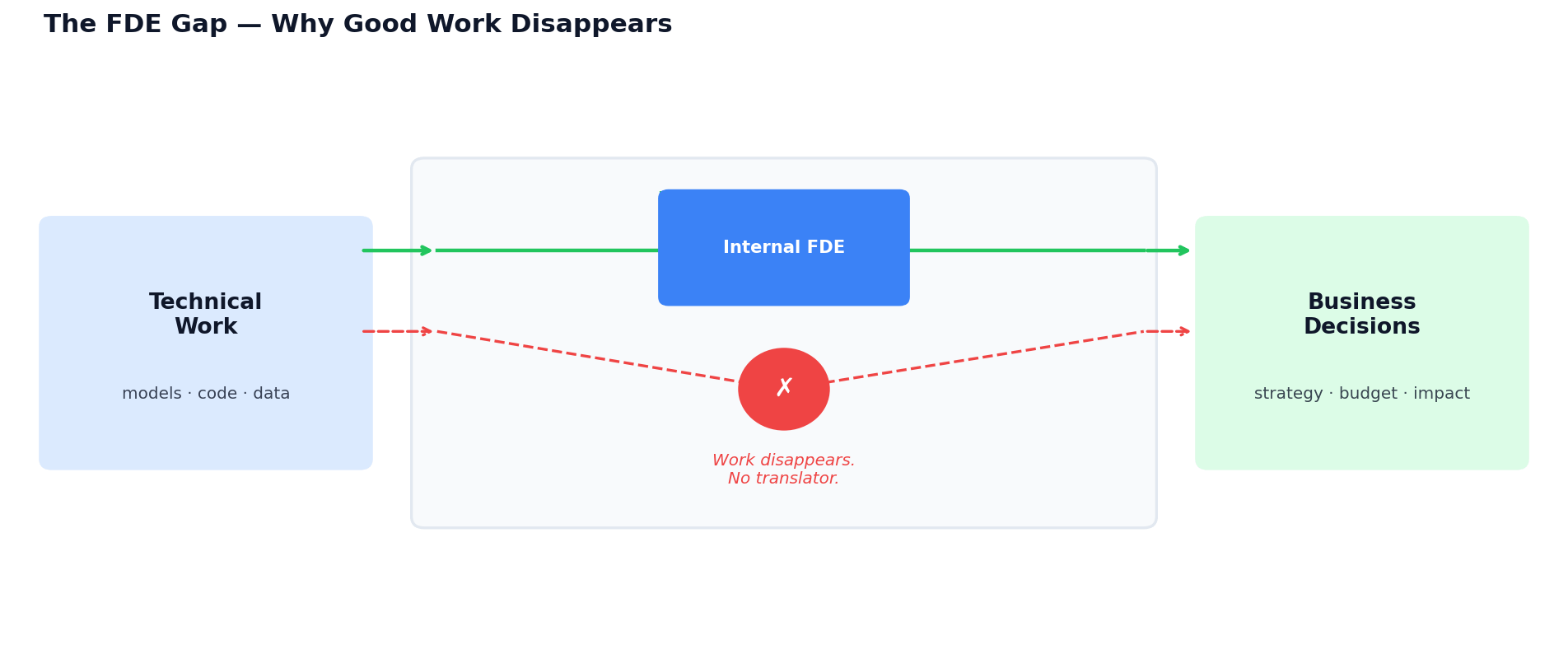
Let me describe something that happens constantly in enterprise data teams.
A team of smart people spends six months building a genuinely excellent model. It performs well on holdout. The business case is solid. The model goes into production.
And then... it gets used by three analysts, never seen by the decision-makers it was built for, and quietly deprecated when a new VP comes in with different priorities.
The code was fine. The data science was fine. The problem was that nobody translated it.
Nobody walked the floors. Nobody told the story in language that connected to the business team's quarterly priorities. Nobody made the downstream teams feel like partners instead of an upstream data source. Nobody built the internal credibility that makes a model a business asset instead of a technical artifact.
This is the FDE gap.
Deploying agents — or any complex AI capability — is fundamentally harder than deploying software. Software generally works the same way every time. With agents, you're deploying the equivalent of work output inside the enterprise. The business expects tasks solved nearly end-to-end. That means someone has to deeply understand the business process, handle model selection, set up evals, manage workflow change, get the data right, and tune the system continuously. It's not a side project. It's a mission-critical engineering role.
In the external FDE model, a vendor does this for you — at enormous cost, with no lasting institutional knowledge. In the internal model, it's you. With years of organizational context they could never have.
What an Internal FDE Actually Does
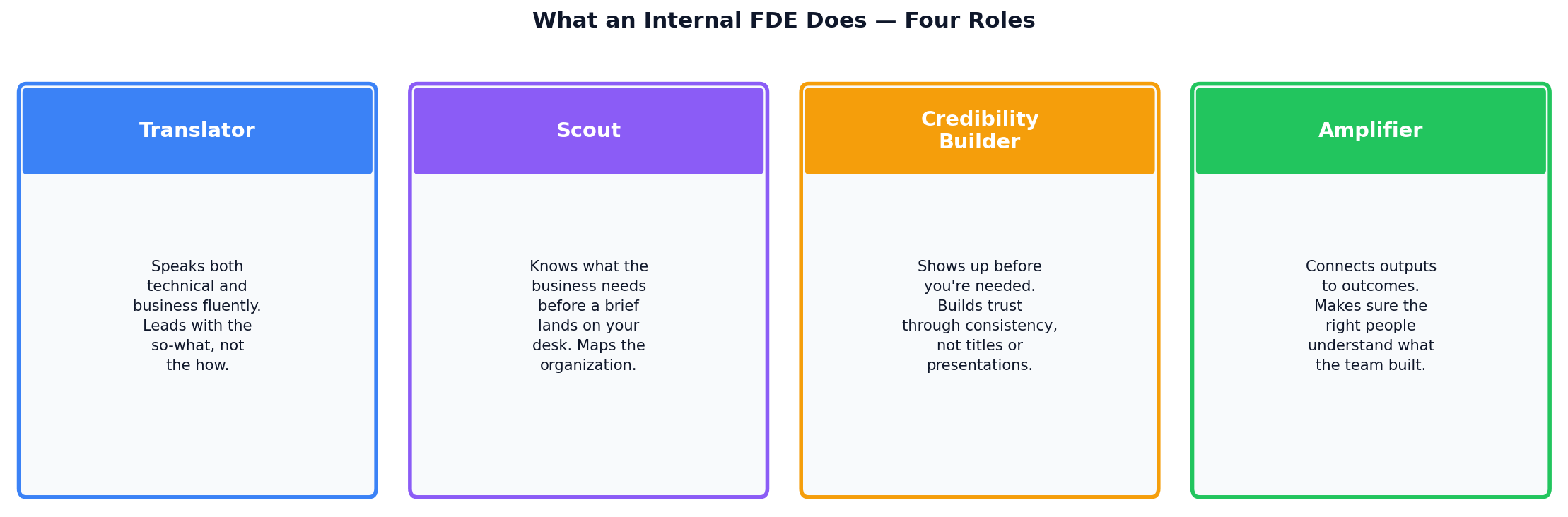
You are the connective tissue between deep technical work and business reality. That means four things, specifically.
You are a translator. When you talk to the underwriting team, you don't lead with AUC scores. You lead with "here's what this means for your loss ratio." When you're presenting to the executive leadership team, you don't lead with model architecture. You lead with the business decision this changes. Translation is not dumbing down — it's respecting your audience enough to meet them in their world.
You are a scout. Before anyone on your team builds anything, you've already had the conversations. You know what the business unit is worried about this quarter. You know where the downstream teams are frustrated. You know which operations lead would be an incredible champion if someone just brought them a relevant prototype. You don't wait for a project brief to discover business needs. You accumulate that intelligence continuously.
You are a credibility builder. Technical credibility comes from doing good work. Business credibility comes from showing up consistently, being honest when something doesn't work, and making people's lives easier before you ask them for anything. The Internal FDE is known before any project starts. When a new initiative needs a data partner, your team's name comes up because you've been in those rooms.
You are an amplifier. Great work that nobody knows about is just expensive hobby time. The Internal FDE makes sure that when the team delivers something valuable, the right people understand what it does, how it was built, and what's possible next. Not with self-promotion, but with clear, consistent communication that connects outputs to outcomes.
Your Unfair Advantage
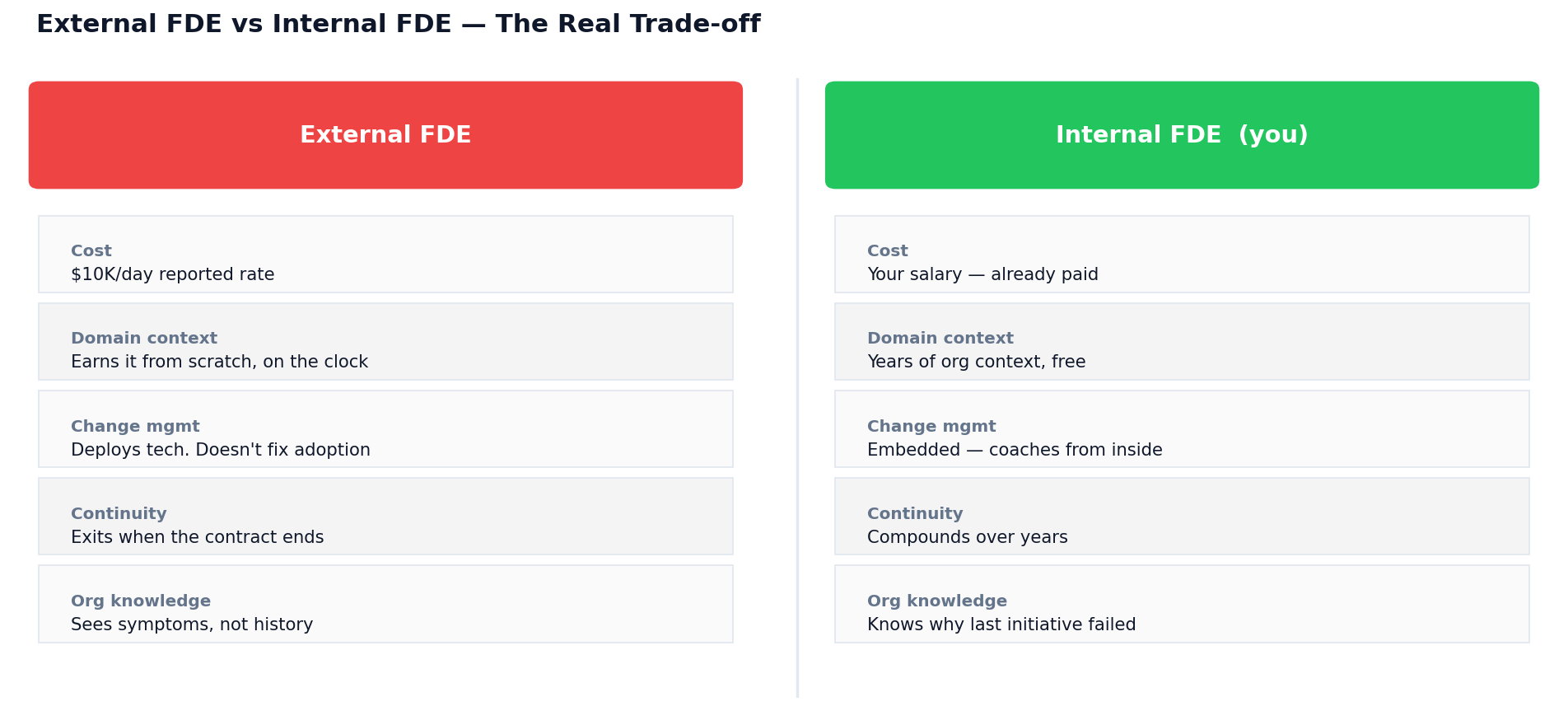
External FDEs bring technical depth and pattern recognition from deploying similar systems across many companies. That's genuinely valuable.
But they lack something you already have: years of accumulated context about how this specific organization thinks, decides, and resists change.
There's a reason the best specialist consultants are almost always people who spent a decade inside the industry before going independent. If you tear your ACL, you want to go to an ACL surgeon — someone who has seen this specific failure mode hundreds of times in this specific context, not a generalist learning on your dime.
You are the ACL surgeon for your company's data problems. You know the internal politics. You know why the last initiative failed. You know which VP will champion something and which one will quietly kill it. You know which downstream team has the best data hygiene and which one will fight every integration request.
External FDEs have to earn that context from scratch, and they're on the clock while they do it. You already have it. The question is whether you're using it.
Lead With Beliefs, Not Features
The most common mistake in internal technical communication: leading with the work instead of the so-what.
"We've built a gradient boosted model with 87 features and a cross-validated AUC of 0.84" is accurate. It also doesn't start a conversation with anyone who isn't already thinking about the same technical problem you are.
Compare it to a belief statement: "I believe our models will only drive value if the business team owns the output, not the AI team." That tells your stakeholders immediately where you stand and why. It gives them something to react to, agree with, or push back on. It starts a real conversation.
This is what the best FDEs do with their clients — they don't open with product specs, they open with a diagnosis of the problem and a clear point of view on what matters. The same applies internally.
Before any major presentation or communication, ask yourself: what's the belief I want this audience to leave with? Work backwards from that.
Building Your Internal Audience
The first people who engage with your work set the tone for everyone else.
If the first reaction to your model readout is a VP saying "this is exactly what I've been asking for," everyone else in the room recalibrates. If the first reaction is "I don't understand what this means," you're spending the rest of the meeting recovering.
This means you need to do pre-work. Not to game the room, but to make sure the first engagers are informed engagers. Before any major internal presentation:
Talk to one or two stakeholders in advance. Not to get their approval, but to understand their current mental model and make sure your framing lands. Ask them what question they'd most want this work to answer. Then answer that question first.
Find your internal champion before you need one. In every business unit that interacts with your team, there's usually someone who "gets it" — who thinks quantitatively, who's frustrated with the status quo, who would love to have a data partner. That person is your ally. Invest in the relationship before you have a project that needs them.
Make your first engagement easy. Leave stakeholders with something clear to do or respond to. Not "let us know if you have questions" — but "we're going to pilot this with two underwriters in Q3 — can you connect us with the right people on your team by end of next week?"
The Communication Types That Build Credibility
Different types of internal communication build different kinds of trust. The most effective Internal FDEs cycle through all four.
Thought leadership: Share a perspective on where AI and data are headed in your specific domain — pricing, risk, claims, whatever your function is. You have a unique vantage point. Nobody else at your company sits at the intersection of the data and the business problem you're closest to. That vantage point is valuable, but only if you share it. Write a short internal piece. Send it to three people you respect. If it resonates, expand it.
Personal stories: The most underused communication type inside enterprise data teams. "Here's what I thought when we started this project, here's what we found, here's what we were wrong about" is more compelling than any polished methodology deck. It's also more credible. Anyone can dress up a success. The willingness to narrate the failure modes, the pivots, the things that surprised you — that's what makes people trust your judgment on the next project.
How-to guides: Technical teams build institutional knowledge that lives in people's heads and disappears when they leave. The Internal FDE turns that knowledge into artifacts. A one-pager on how to use your team's outputs. A short guide on how to read a lift chart for a non-data audience. Documentation that enables the business team to get value from your work without needing you in the room every time. This is leverage.
Predictions: "Here's what I think is going to matter in our space in the next twelve months" is a powerful thing to say internally, especially if you're right more often than not. It positions you as forward-looking, gives leadership something to react to, and often turns into a real project when someone says "actually, we've been thinking about that too."
The Practical Mechanics
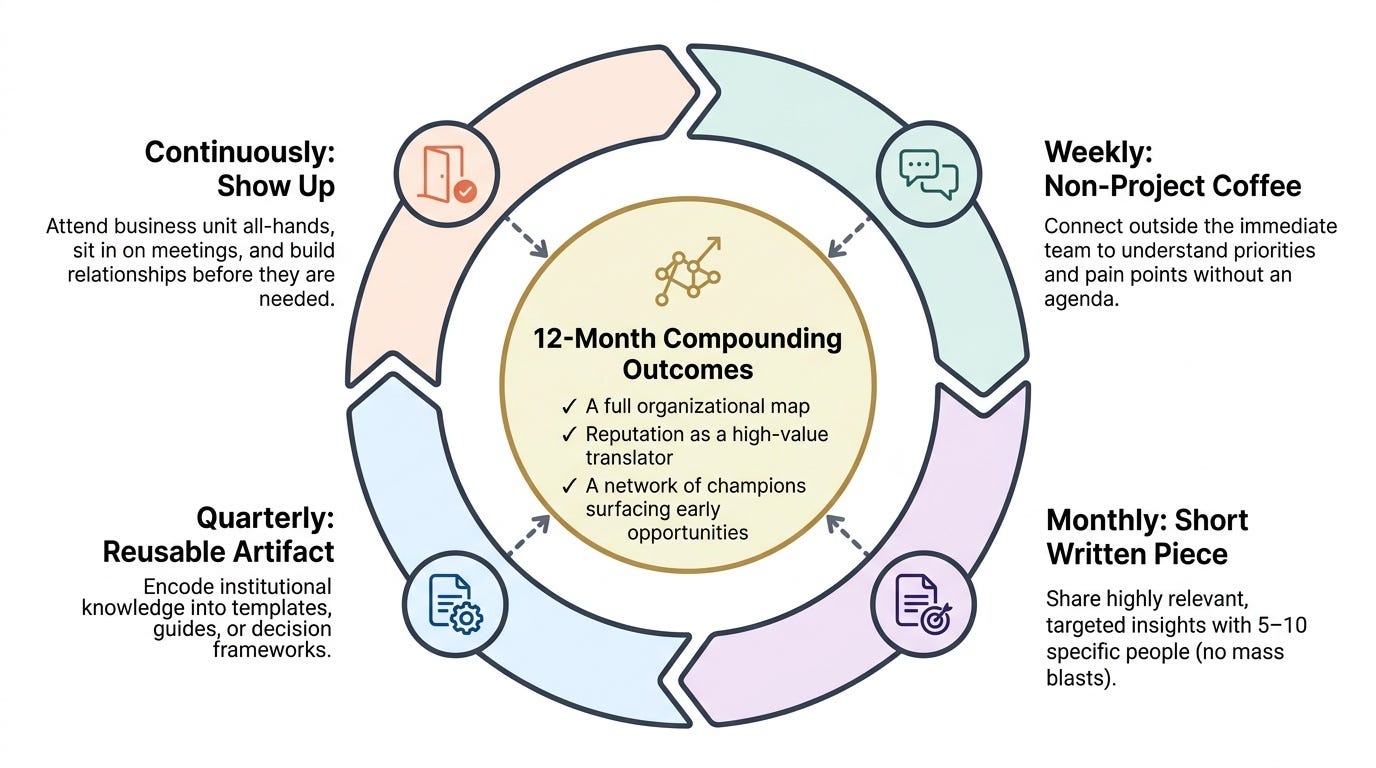
Here's what actually building an internal FDE practice looks like, week to week.
Have one non-project coffee per week. One conversation with someone outside your immediate team that isn't about a current project. Just: what are you working on, what's keeping you up, what do you wish was different? This is how you build your scout intelligence. Over a year, these conversations compound into a map of the organization that nobody else has.
Write one short internal thing per month. It doesn't have to be long. A one-page take on something interesting you've learned. A short summary of a paper that has implications for your work. A retrospective on a project that didn't go as expected. Share it with a small list of people who would genuinely find it interesting. Do not mass-blast to the whole data org. Quality of audience matters more than quantity.
Create one reusable artifact per quarter. The Internal FDE leaves infrastructure behind. What would help the business teams work better with data, even when you're not in the room? A template. A guide. A decision framework. A cheat sheet. Something that gives you leverage without requiring your continuous presence.
Show up before you're needed. The worst time to build relationships with a business unit is when you need something from them on a deadline. Show up at their all-hands when you're invited. Ask to sit in on a team meeting just to understand their workflow better. This is not political maneuvering. It's the basics of being a good colleague in a large organization where teams default to siloing.
The Objection: "I'm a Data Scientist, Not a Communicator"
I've heard this from genuinely excellent technical people, and I want to push back on it.
Communication isn't a personality trait. It's a skill, and like any skill, it improves with practice and feedback. The data scientists who are most effective in enterprise settings aren't necessarily the most naturally outgoing people. They're the people who've built the habit of translating their work into business language, and who do it consistently.
There's also a structural argument here. In a large company, the value of technical work is not determined by the quality of the technical work. It's determined by whether decision-makers trust the team that produced it, understand what it does, and see a path to acting on it. That trust is built through human interaction, not through model cards.
You can be the best data scientist in the building, and if nobody above the technical level knows what you're working on or why it matters, you will have less impact than someone half as technically skilled who communicates well. That's not cynical — it's just how organizations work.
The Internal FDE role is not about becoming a politician or a salesperson. It's about deciding that you care enough about the impact of your work to do the last mile that makes it real.
What You're Really Building
The frustrating thing about doing excellent technical work in a large organization is that excellence is necessary but not sufficient. A model that lives in a notebook, or gets used by three people, or gets deprecated when priorities shift — that model didn't matter, regardless of how technically sound it was.
The Internal FDE closes the gap between good work and real impact. It's the part of the job that nobody assigns you, that doesn't show up in your performance criteria, and that most technical people quietly resent having to do.
But it's also the part that determines whether your work changes anything.
Companies are now paying $10K a day to bring in external people to do this. They're creating new job titles for it. They're embedding engineers inside teams specifically to solve the change management and translation problem that technical teams consistently fail to solve on their own.
You can be that person from the inside. With more context, more continuity, and a fraction of the friction.
That's worth building.
If you're building an AI or data practice inside a large enterprise and want to think through what the Internal FDE role looks like on your specific team, I'd love to hear what you're running into. Drop a reply or send a message.