
The popular story about agents is that they will remove humans from the loop. That framing misses what is actually changing. Humans are not disappearing. They are moving to a different loop.
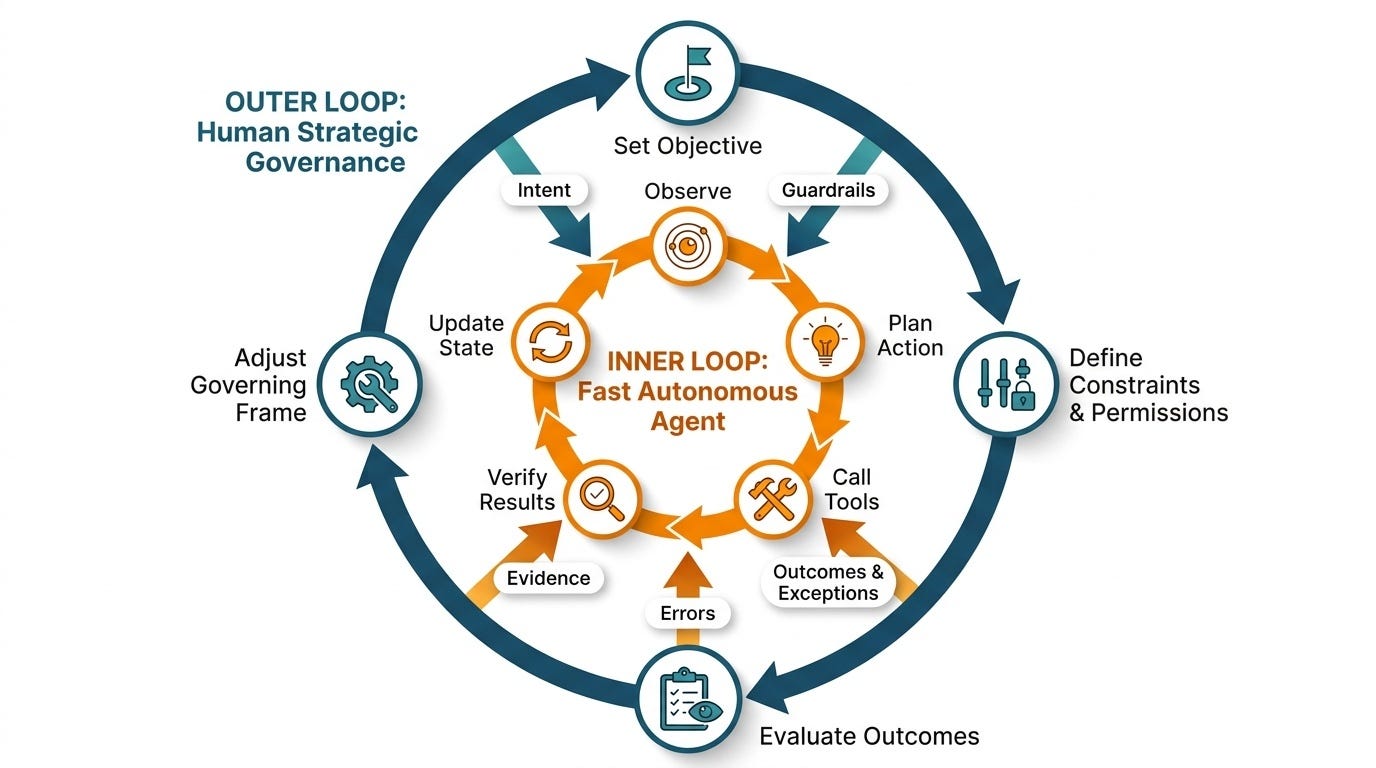
The fast loop belongs to the agent: observe, decide, act, verify, repeat. The slower loop belongs to the human: set intent, define guardrails, evaluate outcomes, and change the system when the pattern of results says it should change.
When people say "the agent did the work," what they usually mean is that the agent handled the short-cycle execution path. The human still shaped the mission, constrained the operating envelope, and decided whether the results were acceptable. That is not removal. That is promotion.
The old mental model was simple: human thinks, human acts, software assists.
The emerging model is different: human defines the frame, agent runs inside it, and software records enough state for the system to be inspectable and correctable.
That changes the role of human judgment. It matters less in the moment-to-moment mechanics of execution and more in the structure around execution.
The new human job is not to click faster than the machine. It is to decide:
What outcome actually matters
What constraints cannot be violated
What tradeoffs are acceptable
What signals mean the system is drifting
When the frame itself needs to change
This is a more strategic role, but it is also a more demanding one. A human in the strategic loop cannot hide behind activity. The system exposes whether the goals, thresholds, and review criteria were well chosen.
That is why the future of agents is not just about autonomy. It is about governance with shorter feedback cycles.
An agent can iterate through a task dozens or hundreds of times faster than a person. It can retry, branch, compare, and recover without waiting for a human to press the next button. But that speed is only useful if someone has defined the objective and the stopping conditions well enough for the fast loop to stay productive.
Without that frame, autonomy degrades into expensive motion. The agent looks busy. Logs fill up. Tools fire. Tokens burn. But the system is not converging on anything worth keeping.
The practical implication is that good human operators will start to look less like operators and more like system designers.
They will spend more time on:
Intent definition
Policy and permissions
Success metrics
Review checkpoints
Exception routing
Post-run diagnosis
And less time on:
Manual execution
Repetitive coordination
Low-level tool invocation
Short-horizon status checking
This is not a hand-wavy organizational shift. It maps cleanly to the engineering structure of an agent system.
At the execution layer, the agent runs a tight control loop. It reads the current state, chooses an action, calls a tool, checks the result, updates the state, and continues.
Above that sits a control plane shaped by humans: goals, policies, task boundaries, escalation rules, budgets, and evaluation criteria.
Above that sits an even slower loop: review the outcomes across many runs, identify patterns of failure or waste, and redesign the frame.
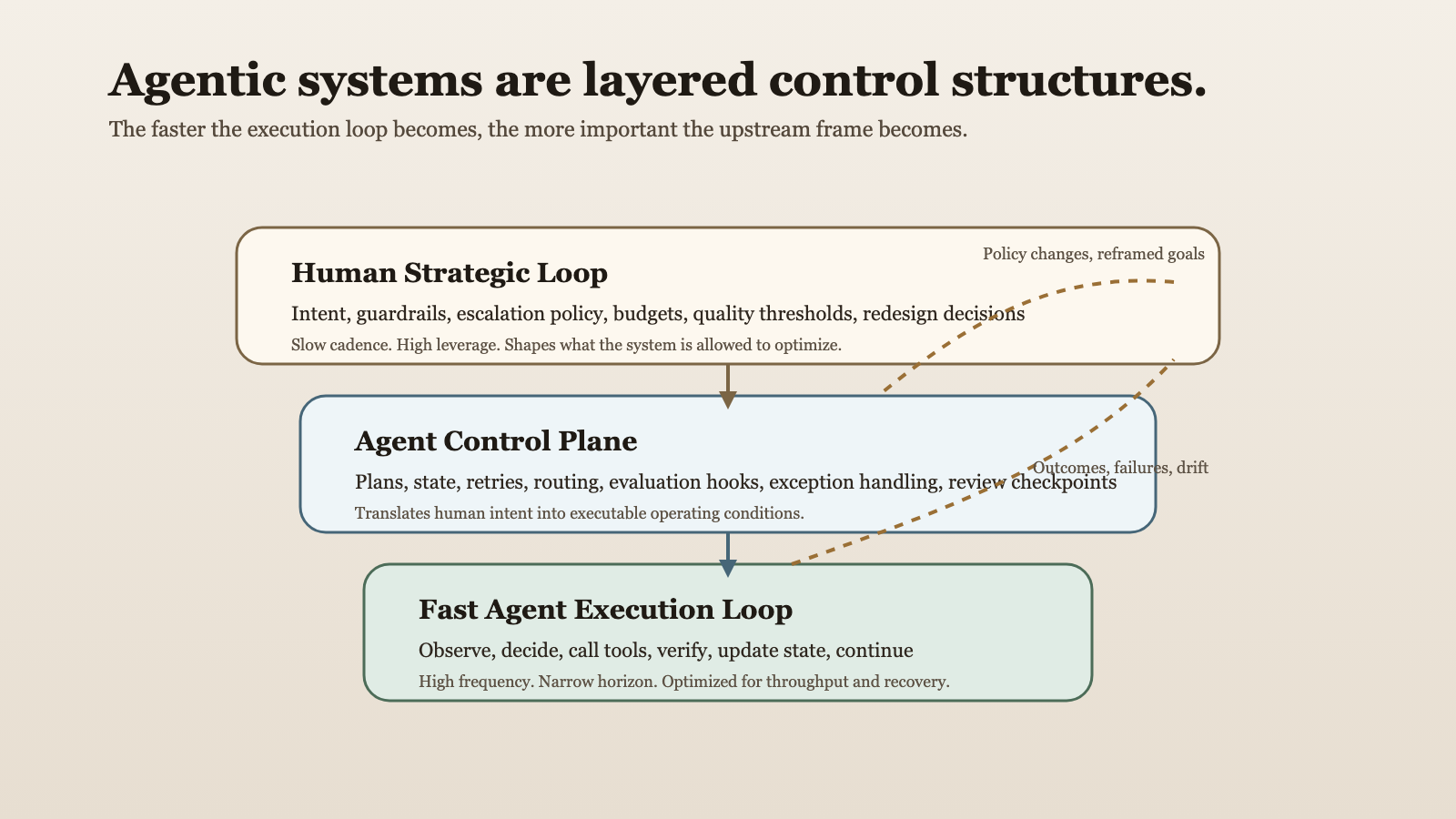
In other words, humans move from the transaction layer to the architecture layer.
That does not make humans less important. It makes their mistakes more consequential and their judgment more leveraged.
A weak worker can be corrected one task at a time. A weak frame gets multiplied across every autonomous run.
That is the real shift agents introduce. They amplify not only execution, but also whatever upstream judgment shaped the execution.
The organizations that benefit most from agents will not be the ones that simply automate the most steps. They will be the ones that become good at designing loops.
They will know how to:
Give agents clear intent without over-specifying every action
Set hard guardrails without freezing the system
Review outputs at the right altitude
Turn repeated failures into better policies
Decide when a human must step back into the fast loop
This also explains why "human in the loop" is now too vague a phrase. The real question is: which loop?
Are humans approving every action in the fast path? Are they only reviewing samples after execution? Are they setting policy weekly and auditing exceptions daily? Are they redesigning the workflow monthly based on aggregate outcomes?
Those are very different systems, and they produce very different economics.
The companies that win with agents will treat loop design as a core capability. They will explicitly decide what runs at machine speed, what gets escalated, what gets logged, what gets measured, and what gets changed when the results stop matching intent.
That is the future of agents.
Not humans removed from the loop.
Humans promoted to a slower, higher-leverage one.